Botly v2 is here: better quality suggestions, smarter replies, and a big upgrade overall.
Read what's newChatfishing: How to Use AI on Tinder Without Sounding Like a Bot
Published on August 4, 2026
Read time 9 minutes
By Leo
On 20 July, Bloomberg published a feature on the dating apps’ growing AI problem. The word doing the work is chatfishing: using ChatGPT or Claude to write the messages you send your matches. Match Group’s chief executive reportedly said there is not much the company can do about it, and per the same reporting, neither Match, Hinge nor Bumble is screening for it.
The obvious disclosure first: we build one of these tools. Our browser extension puts AI reply suggestions inside Tinder and Bumble chats, so we have a stake in this. Read the rest with that in mind.
Here is what we actually think. The problem is not AI, it is generic AI. A slightly boring message that sounds like you beats a polished one that sounds like nobody. Chatfishing is a voice problem before it is an ethics problem, and voice is fixable.
What chatfishing means
Chatfishing is catfishing’s smaller cousin: your photos and your name are real, you are only outsourcing your personality. Searches for the term reportedly spiked around 5,000%, and it is not a fringe habit. According to reporting on the same story, 26% of US adults have used AI for dating help and 49% of Gen Z daters have. The 2025 Match and Kinsey Institute Singles in America survey put AI tool use among daters at 54%, reportedly up 333% year over year.
What generic AI output looks like in a real chat
Everyone recognises it and nobody can name it. Three short examples.
Her: just got back from 16k in the rain, never doing that again
Generic AI: That sounds like quite the challenge! Running in the rain definitely takes dedication. What made you decide to start training?
Sounds like you: 16k in the rain is a medical condition. respect though
Him: haha fair. what do you do for fun?
Generic AI: I love exploring new restaurants, reading, and spending time outdoors! I’m always up for a new adventure. How about you?
Sounds like you: climbing, and arguing about films with people who have not seen them
And the opener, where it is worst. Their profile says they judge you on your coffee order.
Generic AI: Hi Maya! Your profile really caught my eye. I see you’re a coffee connoisseur. What’s your go-to order?
Sounds like you: flat white, no sugar. am i still in the running
None of the good versions is clever. They are short, specific and clearly written by someone who had a thought.
The tells, named plainly
- Over-punctuation and full sentences. Real people send fragments. AI sends a whole sentence with the comma in the right place and a full stop at the end.
- Every reply ends in a question. Acknowledge, compliment, question. Three of those in a row and it reads like an interview.
- Zero specifics. Nothing from their profile, nothing from the last ten messages. The reply would fit any chat with any person, which is the problem.
- It explains the joke. A model worried about being understood lands the joke and then describes it.
- It never sends a two-word reply. Sometimes the right message is “no chance” and nothing else. AI almost never offers that.
The fix is not a better model. It is context.
Fake-sounding output rarely means the model is weak. It means the model was asked to write a dating message with nothing to go on, so it produced the safest average of every dating message ever written. Polite, complete and dead.
Three things change the output more than any model upgrade:
- Who you are. A few real facts about your life, not adjectives.
- How you text. Length, casing, punctuation, whether you use emoji, how often you are actually funny.
- What already happened in this chat. The whole thread, not just the last message you are replying to.
A prompt you can paste into any AI
This works in ChatGPT, Claude or anything else. Paste your chat, then this. Edit the voice lines so they describe you rather than us.
You are helping me reply on a dating app. Write as me, not as an assistant.

How I text:
- lowercase, no full stop at the end of a line
- one line, under twelve words
- dry and understated, never enthusiastic
- fragments are fine. "haha same" is a complete message
- never two questions in a row
- never compliment their looks
- never explain the joke

Rules:
- react to the last message specifically, not to the topic in general
- use something from their profile or earlier in the chat at least half the time
- if the honest reply is three words, send three words
- no emoji unless I used one first

Give me two options. No preamble, no explanation.
Two variants worth trying, depending on how you actually are:
Warm version:
- warm and direct, not sarcastic
- two short sentences maximum
- it is fine to say plainly that I liked something
- no irony as a defence mechanism
- ask a question only when I genuinely want the answer
High-intent version:
- assume this is one of only five matches I have
- every message should move us slightly closer to meeting
- propose something specific by message eight, with an easy way to say no
- no filler, no "how was your weekend"
Then the habit that matters most, and it takes five seconds: edit one word before you send. Swap in a word you would actually use, or delete the last clause. It kills the uncanny-valley feeling almost every time.
How we handle this inside the extension
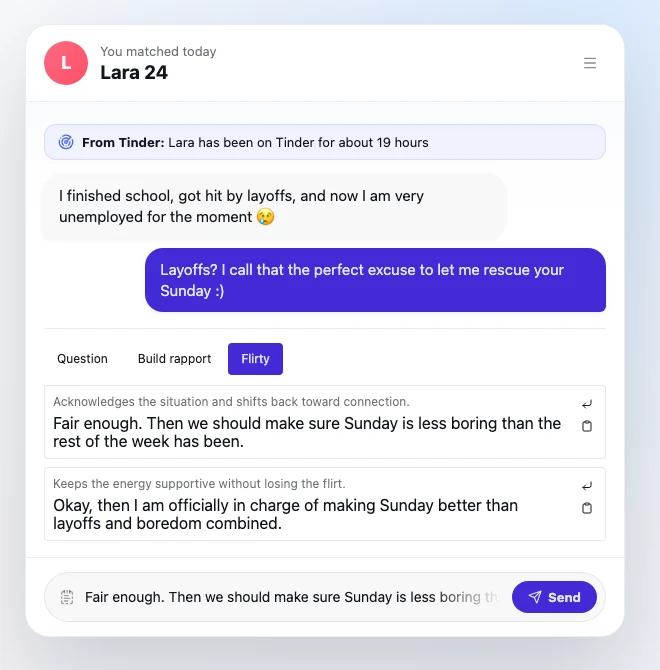
The most useful thing here, and the direct answer to “AI does not sound like me”: the Chat Assistant can read one of your existing chats, analyse how you text in it, and turn that into a reusable Botly reply style. It looks only at your own messages: tone, length, emoji and slang habits, punctuation, the kind of joke you make. The draft opens ready to edit in the style editor, via Open in Botly editor. Pick a chat where you were relaxed, not one where you were trying too hard.
From there it is your prompt, not ours. Each button in the Botly row is a reply style you can edit, and the main field in the editor is literally What should the AI do?, a free text box. Everything in the prompt above belongs in there. Underneath sits a row of personalisation tags (“Tap a tag to insert match info:”): {matchName}, {aboutPersonProfile}, {matchRichFields} and {accountBio} pull in their name, their profile details and your own bio, so the style stops writing in a vacuum.
Then Memories: one fact per line, shared with the Chat Assistant and all your Botly reply styles. Three lines of this beat a paragraph of tone instructions:
I grew up in Vilnius and moved to Copenhagen for work
I climb twice a week and I am bad at it
I do not drink, so bar plans are not my thing
The newest piece is Search my past replies, shipped on 19 July. It is a per-style toggle, off unless you turn it on, and it lets Botly look up how you replied to similar messages before. That is the difference between telling the AI how you text and showing it.
One honest note, because it affects the output: Botly gets the recent part of a conversation rather than all of it, trimmed to the last 5,000 characters. The Chat Assistant gets the full transcript.
Which is why the best move in the product is not a button. Open the Chat Assistant on a thread that went quiet (alt+c, option+c on a Mac) and ask: which of my last three messages killed this? The answer is usually specific, occasionally unflattering, and more useful than a new opener.
Where AI should not write for you
Anything about your feelings. If the message is about what you want, what worries you, or why you went quiet, write it yourself. Badly is fine. Outsourced sincerity is the one thing people always feel.
Anything you would be embarrassed to be caught outsourcing. A good test, and it settles most cases in a second. Help with a first line: fine. An apology: not fine.
The moment you meet. The gap between your chat voice and your real voice is the whole risk, and it is the first thing they notice across the table.
There is also a harder criticism than “it is dishonest” doing the rounds: among people leaning heavily on AI assistance, intent to actually meet has reportedly dropped by 15 to 20 percent. A tool that makes replying frictionless can quietly become a tool for maintaining conversations you were never going to act on. If your chats feel great and your calendar is empty, no prompt here will fix that.
Same at the top of the funnel. If few likes turn into matches, that is a photo problem, and our post on Swipe Stats covers how to look at it honestly. If you write your best messages at 2am, Scheduled Replies beats a better prompt.
FAQ
What is chatfishing?
Using AI to write your dating app messages and presenting them as your own. Unlike catfishing, your photos and identity are real. Only the voice is borrowed.
Is using ChatGPT on Tinder cheating?
There is no rule against it on the major apps, and Match Group’s chief executive reportedly said there is not much the company can do either way. The practical line most people settle on: using AI to say something you would have said anyway is fine, using it to be someone you are not falls apart when you meet.
Can Tinder detect AI-written messages?
As reported by Bloomberg, Match, Hinge and Bumble are not screening for it. Your matches are a different matter: people are getting fast at spotting the acknowledge-compliment-question pattern, and that is what actually costs you.
How do I make AI sound like me?
Give it three things: a few real facts about your life, an explicit description of how you text (length, casing, punctuation, emoji), and the conversation so far. Then edit one word before you send. In our extension, the Chat Assistant can build that voice description from a chat you already had.
Does Botly send messages for me?
No. Botly only suggests, and clicking a suggestion drops it into the app’s own message box for you to edit or delete. Nothing goes out from Botly until you send it yourself. The one feature that does send is Scheduled Replies (Tinder only), and only a message you wrote and scheduled yourself, with a countdown you can abort.
Which apps does this work on?
Tinder and Bumble. WhatsApp Web works too, but only if you switch it on yourself; it is off by default. Hinge appears in this article only because it is in the news, it is not supported by the extension.