Botly v2 is here: better quality suggestions, smarter replies, and a big upgrade overall.
Read what's newTinder is pushing you offline. Getting from match to meeting is still on you.
Published on August 4, 2026
Read time 9 minutes
By Leo
On 23 July, Tinder took its Events feature to nine more cities: New York, Dallas, Denver, Kansas City, Phoenix, Berlin, Munich, Zurich and Geneva. It had been testing in Los Angeles since March. Events connects you with in-person events near you, organised by independent parties rather than by Tinder itself.
The honest read: this is an engagement fix. Reporting around the expansion frames it as a response to declining monthly active users. Tinder needs you to have a reason to come back.
Bumble reached the same conclusion in May, when it said it is dropping the swipe and the women-message-first rule in favour of an AI matchmaker called Bee plus an experience called Dates, designed to help you move from match to meeting in real life without losing momentum.
All of it works on the two ends of the funnel: getting you matched, and getting you out of the house. The middle, the ten or twelve messages where you both quietly decide whether meeting is on the table at all, is untouched. That is where most matches die.
Where it actually dies
You match. Two or three exchanges go well, there is a joke that lands. Then the fourth message is “so what are you up to this weekend”, the fifth is “not much, you?”, and the temperature drops ten degrees.
The reason is human: both people are waiting for the other one to escalate. Suggesting a drink is a small act of exposure, and if they say no, you were the keen one. So you both hold at a level of effort that cannot embarrass you, which is also a level that cannot lead anywhere. Then the chat gets older, until a reply that was normal at four hours feels odd at four days.
Timing beats being clever
If you change one thing, change when you send, not what you send.
Replying at 2am to someone who texts at lunch reads as low effort even when the message is good. It lands at the top of their screen at 7am, next to the alarm and the work email.
Matching someone’s rhythm is a bigger signal than being funny. If they answer within the hour during the day and go quiet after ten, that is their life, and replying inside that window is you fitting into it. This is not about looking busy: two people reachable at the same time can make a plan.
Most people have no idea what their own pattern is. In our browser extension, the Swipe Stats page has a “When you swipe” hourly histogram for roughly the last 90 days, and it is usually a mild surprise. If nearly everything you do on the app happens after 11pm, that is a scheduling problem (more in your swipe stats).
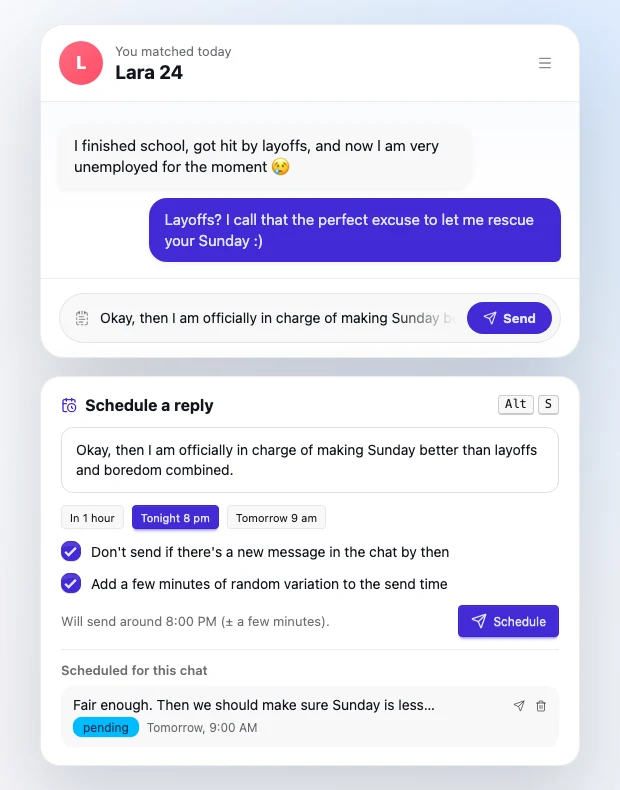
The other half of the fix is writing when you have the energy and sending when they are awake. That is what Scheduled Replies is for, on Tinder only. You compose the message now and pick a time, and it gets typed into Tinder’s own composer at a human pace later. Presets are “In 1 hour”, “Tonight 8 pm” and “Tomorrow 9 am”. “Don’t send if there’s a new message in the chat by then” is on by default, so if they message you first, the scheduled one steps aside.
Nothing sends from a server: the queue lives in the extension on your machine, and sends only happen while you have Tinder open and visible. Before one fires you get a 30-second countdown with Abort and Send now buttons, and touching your keyboard or mouse stops it instantly. Capped at 8 a day, with at least ten minutes between sends. If Tinder is not open when the time comes it waits, and gives up after roughly four hours. Full walkthrough: scheduled replies for Tinder.
How to ask without it turning into an interview
A good ask has three parts:
- Anchor it to something already in the chat, so it reads as a continuation rather than a proposition.
- Propose one specific thing at one specific time. Not “we should do something sometime”.
- Give an easy out, so saying no costs them nothing and you get an answer instead of silence.
Weak: “So we should definitely grab a drink sometime, what does your schedule look like this week?”
That is two chores in one message: invent an activity, then audit your calendar, for someone you have exchanged nine messages with. The polite reply is “yeah for sure, let me check”, and that is where chats die.
Fixed: “You’ve complained about your coffee twice now, so I feel obliged. There’s a place near the canal I like. Thursday after work? If Thursday’s bad just say so, I’m flexible-ish.”
One anchor, one thing, one time, one out. Again, with a plan they already mentioned:
Weak: “That market sounds cool, maybe I’ll see you there haha”
Fixed: “I’ve never actually been to that market. Are you going Saturday? I’ll come if you promise to explain what half of it is. No stress if you’d rather go with friends.”
A Tinder Event is genuinely useful here. It solves the hardest part of the ask, choosing a thing, and neither of you organised it. “There’s this thing on Thursday, I was going anyway” is easier to send than “let me take you out”.
When the chat has already gone quiet
Most people have a few chats that stalled at message five and are now three weeks old. Reviving one is a different writing job from opening one, and the instinct is wrong: apologise for the gap, then ask nothing.
In the extension, Botly suggestions are reply styles you write yourself, each with its own visibility toggles. One is “Only show on stale chats”, described as “Only show when chat inactive for 3 days”, so the button appears only where it belongs. Open “Manage reply styles”, create a style, and paste this into “What should the AI do?”:
You are writing one message to restart a conversation with {matchName} on {platform} that has gone quiet for a few days.

ABOUT {matchName}
{aboutPersonProfile}
{matchRichFields}

ABOUT ME
{aboutAccountProfile}
{memories}

INSTRUCTIONS
- Do not apologise for the gap or point out that it has been quiet.
- Pick up the most concrete thing they already said: a place, a plan, a complaint, a trip. Not their looks.
- One message, one idea, two sentences at most.
- End with something easy to answer in five words.
- Do not repeat a question of mine they already ignored.

TONE OF VOICE
Relaxed, like texting someone I already like. No "hey stranger", no compliments about appearance.
The conversation is sent along automatically, so you never paste it in. Note that Botly works from the most recent 5,000 characters, so on a long thread it reasons from the recent stretch rather than everything you ever said.
More matches at once means more cold openers
Anything that increases how many people you cross paths with also increases how many first messages you owe, and the tenth opener of an evening is always the worst one. The counterpart toggle is “Only show on empty chats”, described as “Designed to generate the first message”. Turn that on for a style built around this:
You are writing the first message to {matchName} on {platform}. There is no conversation yet.

ABOUT {matchName}
{aboutPersonProfile}
{matchRichFields}

ABOUT ME
{aboutAccountProfile}
{memories}

INSTRUCTIONS
- Build the message around one specific detail from their profile. If the profile is thin, pick the most unusual thing visible and ignore the rest.
- Never open with "hey", "hi", or anything about how they look.
- Ask one question, or none and make a statement they can react to. Never two.
- Under 20 words.
- If they mention something they clearly do in person (a sport, a bar, a market), lean towards that.

TONE OF VOICE
Plain and slightly dry. A person typing quickly, not a greeting card.
That last instruction is the one that matters here. An opener built around a real-world activity gives you an anchor to point back at in four days, when it is time to make the ask.
Let something else handle the logistics
The Chat Assistant (toolbar button, or alt+c) can see the conversation transcript and the fields scraped from the match’s Tinder or Bumble profile, which makes it useful for the “what do we actually do” problem. A question worth asking it more or less verbatim:
“Read this chat and their profile. What have we both mentioned that we could realistically do on a weekday evening in this city? Give me three options, and say which one they have actually shown interest in rather than just mentioned.”
The answer is usually mundane, and that is the point: you both named the same neighbourhood, or he mentioned a class on Tuesdays. The plan is the hard part, the sentence is not.
After they say yes, the chat leaves the app
Almost nobody finalises a first date on Tinder. You swap numbers or Instagram handles, and the messages that settle the time, the place and whether it is still on happen elsewhere. A week of momentum can evaporate in a new thread that opens with “hey it’s me from Tinder”.
Botly and the Chat Assistant also run on WhatsApp Web, with a few honest qualifiers. It is opt-in and off by default: you turn it on from the extension’s Options page under “WhatsApp”, and Chrome shows its own permission prompt when you do. It is a smaller version of the feature, because WhatsApp gives the extension no profile or bio to work from: the profile tags in the prompts above resolve to nothing there, so suggestions run on the conversation alone. Scheduled Replies does not work there either, it stays Tinder only. And it is new, on a site whose internals we do not control, so treat it as something to try rather than something to lean on.
What none of this fixes
Better texting does not fix a bad profile. If your matches are mostly people you are not excited about, no amount of well-timed messaging turns that into a good week, and the honest move is to fix the photos.
And be clear about what Events-style features change. More surface area means more matches at once, not better ones: more cold conversations, all starting at zero, competing for the same attention on a Tuesday night. Whether you meet any of them still comes down to about twelve messages, sent at a reasonable hour, one of which contains a specific suggestion. That part has never been automated, and probably should not be. You can just make it less likely that you drop it.